Category: EDCI 336 (Page 1 of 3)

This is a category for the EdTech course. Please add this category in addition to the relevant edtech assignment category(ies).

Free Inquiry #11: Finale!

Well, sometimes good things must come to a (hopefully temporary) end! I have enjoyed getting to learn and gain confidence in the ukulele over the past 11 weeks, and I hope to get to continue playing regularly in the future. For this final post, I thought I would recap what I learned and how it benefits my students in the future.

Originally, I set out to learn more ukulele because I had very limited experience in playing it, only in the fifth grade, which I remember nothing of, with the expectation that I know I was better on the recorder (Maybe it was the clarinet calling me when I was young?) And a few days of classes in university playing, but we did not go in-depth, unfortunately. We did discuss how diverse the ukulele is as an instrument, being able to be played with chords, picking, and in multiple genres and contexts. It is also lighter and smaller which makes it easier for students to physically support, which benefits students prone to wrist and arm injuries. A class set is not horribly expensive (comparatively to other instruments, and you can get deals at conferences often.) There are only 4 strings instead of 6 on the guitar which also makes it a bit easier to get around the instrument.

When I started this project, I had my ukulele tuned in D, which is better for younger students whose voices are in the process or have not begun dropping yet. However, I learned in general that this tuning is all but obsolete in the online ukulele community, where everything is for ukulele in C, so I switched the tuning to my ukulele, having to relearn the chord names that I knew, for example, my D chord was now a C chord, and so on. Fortunately for me at this point, I did not know that many chords, so it was not too difficult.

I began looking up songs I enjoyed listening to and using different websites, I was able to learn many new chords, strumming patterns and songs! I focused on reading through things with fluency, as that is something is something I have always struggled with in my musical career thus far, and teaching students that mistakes happen and it is okay to just keep going if you have a blip is important, and highlighting that ensembles and performers at all levels have to stop and restart or resume at some point in life and that is okay! Emphasizing and modelling this will help build self-efficacy and have the students willing to try things and perform.

I practiced strumming patterns slowly, as I find it challenging to keep on the pattern when singing and playing, and while it is still tricky, I have made progress in that concept.

I thought about assignments and ideas of how to run a ukulele class at the middle or secondary school level, and what assignments would be appropriate and educational for learners. My penultimate post just focuses on the joy of playing, and taking a step away as only an educator and returning to who I am, a musician who is learning something new to enjoy it, not to be the best.

This blog has been an easy way to document my process, and I am sure I will look back on it and smile in the future.

-Katherine
Free Inquiry #10: Music is FUN

This week was a busy one! I played briefly a few times in the evenings to relax after long, tiring days. Honestly, I was well aware I was a work-a-holic, but having this project that forces me to do something not directly homework-related was hard to make myself play and enjoy it. It always felt that I should be doing the year plan, or the unit and lesson plans, or whatever else I had to get done. I found this rather interesting because I am used to practicing daily during my undergrad degree, and my lessons were a class I had to take, but even then I had some of that feeling, but less so. I know how important taking breaks are, but I will admit I am terrible at it. It is something I have to work on in the future so I do not accidentally work 80 hours or more a week with no breaks, because I see myself doing that already. I definitely put productivity above all else in my life, which I know is unhealthy. But it is part of being a musician, practicing feels like work and now that I am finished my music degree, that feeling has never faded. Hopefully, that feeling lessens over time, but it was something that continuously came up, that practice must make perfect, and that takes the enjoyment out of playing. But, learning and growth take time, and I still love music and playing but it takes time to shift my mindset and this inquiry project has started that.

Free Inquiry #9: Assignment Ideas

Part of the reasoning behind selecting the Ukulele for this project was how diverse the instrument is. Throughout the semester, I have been observing at a school with a guitar class, and I thought the ideas and assignments were excellent, so I am borrowing heavily from that teacher.

They always start with a class-wide warm-up, normally with call and response. They have a textbook and have been playing out of that, which could work if there was a ukulele one, but at the beginning of the term the teacher gives each student a pre-compiled songbook, and each class they play a few songs out of that, and the teacher will sing normally, and if the students feel comfortable and able to sing and play at the same time. Some assignments they do are a songwriting assignment and a group composition which they performed for the class. The compositions were lovely and very relaxing. The students stepped up to the challenge and did an incredible job since all of them have been learning to read music as well as learning to play guitar.

These assignments are both excellent for ukulele class as well. Additionally, having the students create their own strumming pattern could be educational because the strumming pattern you use can change the tune you are playing substantially. Near the end of the semester, you could give students the option to pick any song they like (as long as it is lyrically appropriate for school) and learn and record themselves playing it, documenting their progress with video diaries that can be privately uploaded on youtube, emailed directly or on google classroom if that is being used. It can serve as an inquiry for them, and they can play a song they really enjoy and document learning it!

These are ideas for now, but if I was ever teaching a class in the future, I intend to return here to look back on this post and ideas and use some!

-K

Reflection 11: Final Class

The final class! It is rather remarkable that it is already here, but I am glad to have made some progress in the program. In class, we talked about everyone’s team inquiry projects, which is interesting to see what people chose and how they went about it.

Discussing the future of education in groups was interesting, and I think people’s teachable subjects affect their ideas of education and technology in the future. For music, I don’t think that technology is going to take over the methods we use now, but it can help innovate a western, euro-centric, traditional method. Using technology to assess and individualize learning is very valuable to me and I have been creating options to create using technology for assessments in the units I plan. My group talked about outside as a classroom, and I raised accessibility from a perspective of mobility and hearing, and the importance of keeping diverse learners involved and being proactive.

We also discussed our fears and shifts we see how people younger than us interact with technology and we expressed fear of students being unable to be away from their phones to the point they are unable to work a job after school, collaborate with others and communicate ideas through face to face interaction. I see this already in my younger co-workers who have a lower level of basic professionalism (body language, the wording of conversation, etc) and that has a lot to do with their relationships to technology. They are distracted and feel the need to constantly be talking to everyone they are friends with about whatever topic, and most of them and not important enough to warrant the distraction they cause. Even in their own spelling abilities, the constant use of autocorrect with not make them able to spell, or bother learning. Personally, I love autocorrect because I can not spell, not because of technology, just because I am naturally awful at it and my brain can’t think about it or remember words. I think technology is what we allow it to be as teachers. I will be fairly strict on phones personally, because being on your phone in a music ensemble is ruining everyone’s learning, because everyone’s voice matters in music and it is a team activity.

To be frank, I do not think some things we talk about (mainly cell phones in class) need to be such a frequent topic. Maybe this is a controversial opinion, but as professionals, we are being hired to use our ideas, pedagogies and professional opinion to set rules in our classrooms and teach the students. Use your opinion and knowledge of your subject and class to create policies and stick to them. People trust their doctors to make choices for them that are best for them, and teachers are not different in my opinion. Obviously, students will not die if you do not let them be on TikTok in class but have a policy that is rooted in research and professional opinion.

So, what is the future? It is everything and anything we want it to be, but at the end of the day, my pedagogy is centred around one simple question;

“How much is a student WORTH”

This course has been interesting and I found the most value in the legal side (FIPPA/Privacy, copyright and Creative Commons, etc) of technology in the classroom. So, though not everything in this class is overly applicable to music, there are ideas that are useful, like Kahoot (and how rules change), basic editing, and ways to use technology to collaborate anonymously with peers and give feedback, among other things. I appreciate what we went over and if I TOC in the future I will use more of these methods. So, thank you for this term, and my apologies I couldn’t bring the FM, the flooding has delayed it.

Sincerely,

-Katherine

Reflection #10: November 23

Today we briefly reviewed Tracy’s talk from last week, and voted on more EdCamp ideas, then participated in those.

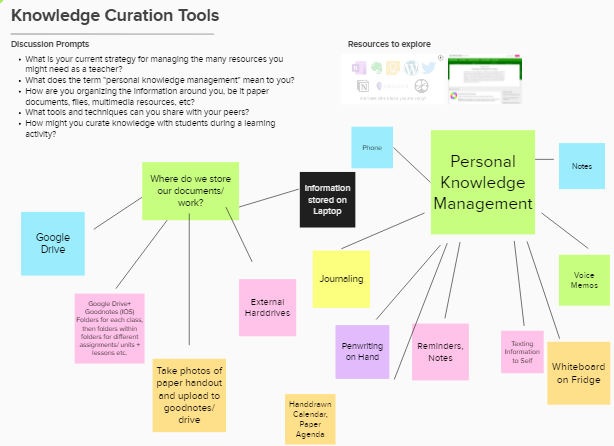
I was in the Knowledge curation group, it was kind of nice to talk about how other people organize their life, and the different ways they interact with similar tools that I use.

Personally, the organization of information is important for my life and work habits. I personally use tools that will sync to multiple devices, for ease of access and if I do not bring the same devices every day. I currently use google drive and goodnotes for IOS, along with an app called Collanote, which I use for my to-do list on my iPad, which I modify for each situation. I have one page for all assignments coming up that week, and their due dates, then a page with all due dates for the upcoming week(s) and I modify that note each day in order what I need to get done that day. I still use a paper agenda that has ALL due dates in all my courses that I write in at the beginning of the term, along with days that I work. I like having information in multiple places because it is more likely that I will remember it. Here is our brainstorming:

I noticed a common thread of reminders app on phones, and tablet users using OneNote or Goodnotes, or a similar app that syncs between devices, and google drive was also very common. One idea I thought was great was using voice notes for just communicating quick ideas, just on your phone, which I have never done before, and I think it could be something that works for me!

I thought Rick did a great job with helping our zooming-in classmate be actively involved and able to participate and hear what was going on, and it made me happy and brought a smile to my face watching him move around and stand up and hold the microphone so the in-person folks could be heard.

The simulation group was interesting to hear what they said. Personally, I am a huge fan of google earth, I just find it very amusing, and I love geography and exploring the world, and I can do that for free on google, which is incredible. I could see myself using google earth in my classroom to show my students the places that our repertoire is inspired by. Places like Mt. Everest, Machu Picchu, The Great Wall of China, and many more. Geographical location affects culture and the way people live their life all around the world, and google earth is a great way to do that. Even watching a youtube video like this one by Elia Saikaly:

It is remarkable the semester is almost over already, one more week!

Reflection 9: Tracy Humphreys from BCEd Acess- Technology and Inclusion

This topic is really near and dear to my heart, and I love what society does, and the fact it is volunteer-run is incredibly powerful. As someone who has felt the effects of lack of inclusive education and technology on a personal level, what BCEdAccess is doing is very important to me and my pedagogy, and the sign of hopefully moving forward. Though, the fact that this is run by volunteers and not by government officials, which highlights where we still need to go.

The example of ableism is incredibly important; I have had issues around this for my life. I have had a hearing loss since I was around 2 years old, and my whole experience has revolved around ableism, both internal and external. I got my first hearing aid when I was in university and did not see myself as having a disability until I registered with CAL in my second year at UVic, but honestly until this school year. I had always just had the opinion that “It isn’t that severe, I know people who are harder of hearing than me or have a more severe type of brittle bones, I am fortunate” That still follows me today, and the road to self-acceptance is not a straight one, and the most blatant ableism I have faced has been in the post-secondary system, and being told that my disability isn’t relevant to the material, when it was a listening based assignment.

As I mentioned in the chat in class, I am receiving my first FM system THIS YEAR, (it should arrive within the next week or two as I write this) 21 years after my hearing loss was identified, and the factors I just mentioned factor into that, and also, these systems can be starting at $1000 +. I went through an organization called the ATCB and started through CAL, and they are able to give assistive technology to people who can demonstrate financial need through StudentAidBC, and they are able to supply at least hearing-related technology. I am unsure of their capacity in the public school system, but I thought it could be useful to name the people who helped me in case someone else is in my situation. We as teachers need to be sensitive that these students may not even actively identify as disabled but need support. Self-advocacy is incredibly draining in today’s world as a young person, and assistive technology is very expensive, hearing aids at the most basic levels can be easy $1500+ for each ear ($3000+ for a pair of course) This is my first experience using live transcriptions in zoom, and I am incredibly impressed. I had a whole school year and not one professor used it.

When I was in school and before I learned to accept and celebrate who I am, I felt much more shame and “different” from my peers, because I spent many years being separated from my classes in PE and my hearing began to factor into my identity as a music student, that how much representation matters in all degrees. I have never seen a musician who has a smaller hearing loss and can still participate and get a music degree. We see the fully deaf or blind, etc. And that representation is equally important, but representation at ALL levels matters and that is why I am open about my hearing loss because I have found people have been grateful for my voice and telling my story and being open. It is part of my identity and that is not a bad thing, it is who I am is just as important as my identity as a musician, teacher candidate, and everything else that makes me who I am, and informs my perspective, pedagogy and choices, and there is value in that. This realization was a product of ableism that I faced and why I chose to be much more open in a class setting which is particularly rare in a music classroom.

What makes this difficult for teachers?

My assumptions would be legal and confidentiality related of course, and from my experience in my undergraduate degree, is that teachers lack knowledge around special needs and accommodations and how to support them without overstepping a boundary or making an accidental misjudgment or saying the wrong thing. If you do not experience ableism and the experience of a disabled person, you will not have the experience, and when people do not want to learn how to advocate for students or feel uncomfortable speaking for students, especially older students. At the secondary level especially, I beg teachers and professionals to listen to their disabled students, because it is their unique experience and they know themselves better than anyone else will and listen to their voice and story.

As a summary, I know I went off the rails topic-wise in this reflection, but this topic is so important to me, my story and my pedagogy. I am so grateful for Tracy, her time, her and her organization’s work, and having a conversation about special needs in the classroom, which doesn’t always happen. Everything in my pedagogy revolves around a very simple question, which has both simple and more complex answers. That question is “How much is a student WORTH?” They are worth everything, and deserve equity, and access to education, and are worth everything that goes into accessibility.

This is the FM system I am going to be using-https://www.phonak.com/ca/en/hearing-aids/accessories/roger-on.html Which can be controlled by an app on my phone and uses a compilot, which connects to the hearing aid and is worn around the neck. I am hoping (from the information I have received it should) it arrives before semester ends, if not I am happy to bring it next term!

Free Inquiry 8: Reading Break!

This week, I decided to just play a bit, and take a step back from always trying to find new technology to use and explore and go back to just playing to enjoy it. This has always been important to me when I have been forced to learn something or practice something specific (either of my own choices, such as this project, or because I am having to play and learn specific pieces for my undergrad studies) It is not a negative thing, but if you do something only because you have to, and not because you want to you will eventually resent it and burn out. The whole point of this inquiry is to learn something new and enjoy doing something within the hectic world of the program, and so I chose to just play to enjoy it.

Through this entire semester I have been using websites to provide chords to songs I want to play. The websites I have used most frequently are https://www.ukulele-tabs.com/ and https://www.ultimate-guitar.com/ The ladder is great because it has guitar and ukulele, so it offers more advantages to learners if they want to learn both instruments!

Playing-wise, I just played some songs through, practiced some strumming patterns and practiced really slow chord changes, aiming for precision. Taking a step back sometimes is really what is best for us in the long run, and I am glad reading break gave me that time.

Reflection #8: Distributed Learning

I wanted to begin with a note of gratitude. I am very grateful for the opportunity to discuss the future of the program, and I hope they know we really appreciate their time to listen to us. It is never easy to hear constructive feedback about a program that takes so much collaborative work to put together, but I hope they know we want to help make this program the best it can be for future students!

I thought the mad tea activity was fun, but I do wonder how accessible it is, personally, I could not hear well and most people were also having a hard time hearing each other speak.

I think online learning is amazing. I know people harp on zoom but the atmosphere of online learning has opened up the world of education to people who are disabled and chronically ill and have them be able to participate equally and equitably. I certainly learned that most people do not consider those people, and the desire to return to in-person learning is incredibly disheartening because we made steps forward in regards to accessibility but we then took 2 steps back after 3 steps forward. In fact, I had an in-person class from January- April 2021 and if someone was sick and could not be there by Uvics own rules, the professor would not give the option to record the lecture or have them zoom in, which I found frustrating and disheartening. We proved we can be accessible for everyone and then immediately ditched it as soon as possible. As someone with hearing loss, I have a horrible time hearing people wearing masks, it was amazing to be able to turn the volume up when I needed to and enabled me to participate in class, which there are definitely situations now that I cant fully participate in because I can’t hear who is speaking.

This shift showed me that ableism does exist today, even in a pandemic. Universities and schools were more interested in bringing students back to in-person education before the consideration of safety. Though, I do not blame individual institutions, but rather the systems they are built on. In-person education is great and you cant replicate the in-person experience, but also educators need to consider that some folks cant always experience in-person education and the glorification of in-person education above all else is exclusionary in nature. If the system isn’t designed to have people connect online, they won’t.

Giving students an option to participate can be a great idea, though it will not work in most of my classes when I am a teacher, music is a team activity normally and zoom and music do not collaborate together. But I support that it should be an option for students to be able to participate if they are unable to be in class. In fact, I had a classmate last year who showed up to class on zoom from the dentist, and the professor was able to teach us and be a vice principal, and she taught us from her car when her school lost power! One more story, my professor had to go to Vienna and Hungary to conduct orchestras this past school year, and we were able to have classes and he taught us while he was there, and he made a video for us showing us different locations we had talked about in class. When he was flying home, we were supposed to write a midterm and we were waiting for marks from him because he said if he didn’t mark these assignments by a certain day we didn’t have to write the test that next day, and then we were trying to contact him, and we got admin involved, and we had the midterm delayed because no one could find him. Well, anyway that’s the story of how we lost our professor in online learning.

It is nice to be on reading break officially, and it’s hard to believe we are only a few weeks away from being done one semester!

Free Inquiry #7: Yousition Part 2

As promised in my last post, this week I have been working on using the Yousition app. I mainly explored the tablature (tab) section, and I thought it explained everything very well. As someone with musical experience who can’t read tab, I thought they explained it well. It is done through video and demonstrated and paced well. They use the sound of the strings to reinforce the learning of the string numbers in the TAB staff, which I think is a great way to do it because it helps develop aural skills from the beginning of the learning experience. They had practice and the app uses the microphone of the device (if you give it permission to do so) to give feedback and assess your playing. The app then has a song to play along to and it visually shows the beats on the TAB staff with a line that bounces on the staff when you need to play, which is really quite amusing to watch. I will attach a video of a guitar lesson, which is laid out the same way.

I looked briefly at the chord course as well, and found that it was also laid out well, and explained with audio examples each note in the chord in TAB and then its notation on a chord chart, so learners can understand how it is built and how to read it. I think this app is very well laid out for beginners!

Free Inquiry #6: App!

This week I found an app to use. It’s called Yousition and it is a free app on apple, I would assume on android as well. You can choose from guitar, piano, ukulele, and voice. It begins at the very beginning, including how to hold the ukulele, how to pluck the string, and how to tune and includes a tuner, which is nice because it eliminates the need for another app or fora physical tuner (which I have, but it will save money if teaching a ukulele class to not have to buy several tuners!) It has different courses to pluck, to learn tablature (which I am definitely going to explore for my next post!) How to use your left hand on the frets, using different fingers to play notes, and playing chords! It has 9 levels that gradually increase in complexity, scaffolding the learning. It looks like there can be a paid section for more lesson time, but the basics are free. This could also be something that students could fundraise for and pay for that way if it was something they were very interested in. I am excited to get to use this app and explore it more in the next week, and think it is a great starting point for people to learn the basics with clear, concise guides for free!

« Older posts