Category: EdTech Reflections (Page 1 of 2)

This is the category to apply to your weekly reflection posts from the course.

Reflection 11: Final Class

The final class! It is rather remarkable that it is already here, but I am glad to have made some progress in the program. In class, we talked about everyone’s team inquiry projects, which is interesting to see what people chose and how they went about it.

Discussing the future of education in groups was interesting, and I think people’s teachable subjects affect their ideas of education and technology in the future. For music, I don’t think that technology is going to take over the methods we use now, but it can help innovate a western, euro-centric, traditional method. Using technology to assess and individualize learning is very valuable to me and I have been creating options to create using technology for assessments in the units I plan. My group talked about outside as a classroom, and I raised accessibility from a perspective of mobility and hearing, and the importance of keeping diverse learners involved and being proactive.

We also discussed our fears and shifts we see how people younger than us interact with technology and we expressed fear of students being unable to be away from their phones to the point they are unable to work a job after school, collaborate with others and communicate ideas through face to face interaction. I see this already in my younger co-workers who have a lower level of basic professionalism (body language, the wording of conversation, etc) and that has a lot to do with their relationships to technology. They are distracted and feel the need to constantly be talking to everyone they are friends with about whatever topic, and most of them and not important enough to warrant the distraction they cause. Even in their own spelling abilities, the constant use of autocorrect with not make them able to spell, or bother learning. Personally, I love autocorrect because I can not spell, not because of technology, just because I am naturally awful at it and my brain can’t think about it or remember words. I think technology is what we allow it to be as teachers. I will be fairly strict on phones personally, because being on your phone in a music ensemble is ruining everyone’s learning, because everyone’s voice matters in music and it is a team activity.

To be frank, I do not think some things we talk about (mainly cell phones in class) need to be such a frequent topic. Maybe this is a controversial opinion, but as professionals, we are being hired to use our ideas, pedagogies and professional opinion to set rules in our classrooms and teach the students. Use your opinion and knowledge of your subject and class to create policies and stick to them. People trust their doctors to make choices for them that are best for them, and teachers are not different in my opinion. Obviously, students will not die if you do not let them be on TikTok in class but have a policy that is rooted in research and professional opinion.

So, what is the future? It is everything and anything we want it to be, but at the end of the day, my pedagogy is centred around one simple question;

“How much is a student WORTH”

This course has been interesting and I found the most value in the legal side (FIPPA/Privacy, copyright and Creative Commons, etc) of technology in the classroom. So, though not everything in this class is overly applicable to music, there are ideas that are useful, like Kahoot (and how rules change), basic editing, and ways to use technology to collaborate anonymously with peers and give feedback, among other things. I appreciate what we went over and if I TOC in the future I will use more of these methods. So, thank you for this term, and my apologies I couldn’t bring the FM, the flooding has delayed it.

Sincerely,

-Katherine
Reflection #10: November 23

Today we briefly reviewed Tracy’s talk from last week, and voted on more EdCamp ideas, then participated in those.

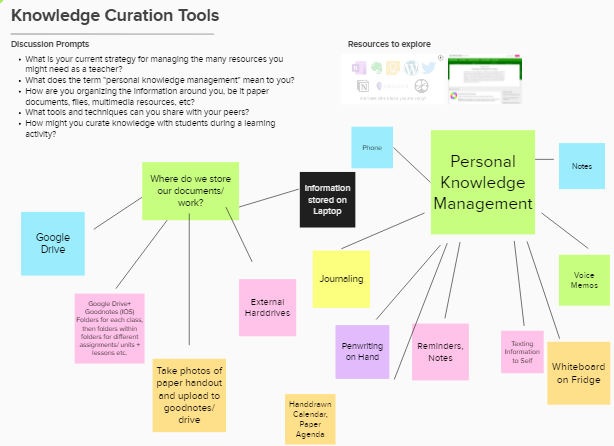
I was in the Knowledge curation group, it was kind of nice to talk about how other people organize their life, and the different ways they interact with similar tools that I use.

Personally, the organization of information is important for my life and work habits. I personally use tools that will sync to multiple devices, for ease of access and if I do not bring the same devices every day. I currently use google drive and goodnotes for IOS, along with an app called Collanote, which I use for my to-do list on my iPad, which I modify for each situation. I have one page for all assignments coming up that week, and their due dates, then a page with all due dates for the upcoming week(s) and I modify that note each day in order what I need to get done that day. I still use a paper agenda that has ALL due dates in all my courses that I write in at the beginning of the term, along with days that I work. I like having information in multiple places because it is more likely that I will remember it. Here is our brainstorming:

I noticed a common thread of reminders app on phones, and tablet users using OneNote or Goodnotes, or a similar app that syncs between devices, and google drive was also very common. One idea I thought was great was using voice notes for just communicating quick ideas, just on your phone, which I have never done before, and I think it could be something that works for me!

I thought Rick did a great job with helping our zooming-in classmate be actively involved and able to participate and hear what was going on, and it made me happy and brought a smile to my face watching him move around and stand up and hold the microphone so the in-person folks could be heard.

The simulation group was interesting to hear what they said. Personally, I am a huge fan of google earth, I just find it very amusing, and I love geography and exploring the world, and I can do that for free on google, which is incredible. I could see myself using google earth in my classroom to show my students the places that our repertoire is inspired by. Places like Mt. Everest, Machu Picchu, The Great Wall of China, and many more. Geographical location affects culture and the way people live their life all around the world, and google earth is a great way to do that. Even watching a youtube video like this one by Elia Saikaly:

It is remarkable the semester is almost over already, one more week!

Reflection 9: Tracy Humphreys from BCEd Acess- Technology and Inclusion

This topic is really near and dear to my heart, and I love what society does, and the fact it is volunteer-run is incredibly powerful. As someone who has felt the effects of lack of inclusive education and technology on a personal level, what BCEdAccess is doing is very important to me and my pedagogy, and the sign of hopefully moving forward. Though, the fact that this is run by volunteers and not by government officials, which highlights where we still need to go.

The example of ableism is incredibly important; I have had issues around this for my life. I have had a hearing loss since I was around 2 years old, and my whole experience has revolved around ableism, both internal and external. I got my first hearing aid when I was in university and did not see myself as having a disability until I registered with CAL in my second year at UVic, but honestly until this school year. I had always just had the opinion that “It isn’t that severe, I know people who are harder of hearing than me or have a more severe type of brittle bones, I am fortunate” That still follows me today, and the road to self-acceptance is not a straight one, and the most blatant ableism I have faced has been in the post-secondary system, and being told that my disability isn’t relevant to the material, when it was a listening based assignment.

As I mentioned in the chat in class, I am receiving my first FM system THIS YEAR, (it should arrive within the next week or two as I write this) 21 years after my hearing loss was identified, and the factors I just mentioned factor into that, and also, these systems can be starting at $1000 +. I went through an organization called the ATCB and started through CAL, and they are able to give assistive technology to people who can demonstrate financial need through StudentAidBC, and they are able to supply at least hearing-related technology. I am unsure of their capacity in the public school system, but I thought it could be useful to name the people who helped me in case someone else is in my situation. We as teachers need to be sensitive that these students may not even actively identify as disabled but need support. Self-advocacy is incredibly draining in today’s world as a young person, and assistive technology is very expensive, hearing aids at the most basic levels can be easy $1500+ for each ear ($3000+ for a pair of course) This is my first experience using live transcriptions in zoom, and I am incredibly impressed. I had a whole school year and not one professor used it.

When I was in school and before I learned to accept and celebrate who I am, I felt much more shame and “different” from my peers, because I spent many years being separated from my classes in PE and my hearing began to factor into my identity as a music student, that how much representation matters in all degrees. I have never seen a musician who has a smaller hearing loss and can still participate and get a music degree. We see the fully deaf or blind, etc. And that representation is equally important, but representation at ALL levels matters and that is why I am open about my hearing loss because I have found people have been grateful for my voice and telling my story and being open. It is part of my identity and that is not a bad thing, it is who I am is just as important as my identity as a musician, teacher candidate, and everything else that makes me who I am, and informs my perspective, pedagogy and choices, and there is value in that. This realization was a product of ableism that I faced and why I chose to be much more open in a class setting which is particularly rare in a music classroom.

What makes this difficult for teachers?

My assumptions would be legal and confidentiality related of course, and from my experience in my undergraduate degree, is that teachers lack knowledge around special needs and accommodations and how to support them without overstepping a boundary or making an accidental misjudgment or saying the wrong thing. If you do not experience ableism and the experience of a disabled person, you will not have the experience, and when people do not want to learn how to advocate for students or feel uncomfortable speaking for students, especially older students. At the secondary level especially, I beg teachers and professionals to listen to their disabled students, because it is their unique experience and they know themselves better than anyone else will and listen to their voice and story.

As a summary, I know I went off the rails topic-wise in this reflection, but this topic is so important to me, my story and my pedagogy. I am so grateful for Tracy, her time, her and her organization’s work, and having a conversation about special needs in the classroom, which doesn’t always happen. Everything in my pedagogy revolves around a very simple question, which has both simple and more complex answers. That question is “How much is a student WORTH?” They are worth everything, and deserve equity, and access to education, and are worth everything that goes into accessibility.

This is the FM system I am going to be using-https://www.phonak.com/ca/en/hearing-aids/accessories/roger-on.html Which can be controlled by an app on my phone and uses a compilot, which connects to the hearing aid and is worn around the neck. I am hoping (from the information I have received it should) it arrives before semester ends, if not I am happy to bring it next term!

Reflection #8: Distributed Learning

I wanted to begin with a note of gratitude. I am very grateful for the opportunity to discuss the future of the program, and I hope they know we really appreciate their time to listen to us. It is never easy to hear constructive feedback about a program that takes so much collaborative work to put together, but I hope they know we want to help make this program the best it can be for future students!

I thought the mad tea activity was fun, but I do wonder how accessible it is, personally, I could not hear well and most people were also having a hard time hearing each other speak.

I think online learning is amazing. I know people harp on zoom but the atmosphere of online learning has opened up the world of education to people who are disabled and chronically ill and have them be able to participate equally and equitably. I certainly learned that most people do not consider those people, and the desire to return to in-person learning is incredibly disheartening because we made steps forward in regards to accessibility but we then took 2 steps back after 3 steps forward. In fact, I had an in-person class from January- April 2021 and if someone was sick and could not be there by Uvics own rules, the professor would not give the option to record the lecture or have them zoom in, which I found frustrating and disheartening. We proved we can be accessible for everyone and then immediately ditched it as soon as possible. As someone with hearing loss, I have a horrible time hearing people wearing masks, it was amazing to be able to turn the volume up when I needed to and enabled me to participate in class, which there are definitely situations now that I cant fully participate in because I can’t hear who is speaking.

This shift showed me that ableism does exist today, even in a pandemic. Universities and schools were more interested in bringing students back to in-person education before the consideration of safety. Though, I do not blame individual institutions, but rather the systems they are built on. In-person education is great and you cant replicate the in-person experience, but also educators need to consider that some folks cant always experience in-person education and the glorification of in-person education above all else is exclusionary in nature. If the system isn’t designed to have people connect online, they won’t.

Giving students an option to participate can be a great idea, though it will not work in most of my classes when I am a teacher, music is a team activity normally and zoom and music do not collaborate together. But I support that it should be an option for students to be able to participate if they are unable to be in class. In fact, I had a classmate last year who showed up to class on zoom from the dentist, and the professor was able to teach us and be a vice principal, and she taught us from her car when her school lost power! One more story, my professor had to go to Vienna and Hungary to conduct orchestras this past school year, and we were able to have classes and he taught us while he was there, and he made a video for us showing us different locations we had talked about in class. When he was flying home, we were supposed to write a midterm and we were waiting for marks from him because he said if he didn’t mark these assignments by a certain day we didn’t have to write the test that next day, and then we were trying to contact him, and we got admin involved, and we had the midterm delayed because no one could find him. Well, anyway that’s the story of how we lost our professor in online learning.

It is nice to be on reading break officially, and it’s hard to believe we are only a few weeks away from being done one semester!

Reflection #7: PSII

This week in class, I found the idea interesting, and seeing how PSII does free inquiry is great, it still leaves me wondering how that works in a fully public school. In my class before his presentation, I had the opportunity to talk to a teacher at a local private school, who also follows an inquiry-based method, using a global International Baccalaureate (IB) program. https://www.ibo.org/, which is a more structured inquiry style, and still uses the traditional north American system with classes. The private school is a fully independent school with much higher tuition fees and an extremely monetarily privileged school community. These two examples of full systems based on inquiry both in the private systems really make me wonder how this could work in the public system, where the demographics and socio-economic situations will vary.

Equity in education is extremely important in my philosophy, and I have a dilemma with the private system because I feel the representation isn’t an accurate reflection of the people who are in the community and representation is a crucial part of learning.

I know Oak Bay is a public school, but the community is still financially very well off comparatively. When students come from economic backgrounds and live in wealthy neighbourhoods, privilege still exists. I have had the opportunity to take a class with a teacher from Oak Bay high school, and their financial availability within the families is remarkably different, compared to even what I experienced in a high school in district 61 that was also more well off than many schools in British Colombia. So while it will be very interesting to hear about how it runs at Oak Bay, it leads me to the question of can an inquiry-based system work at a school where the socioeconomic framework isn’t as ideal as the schools I have heard. I want it to work, but have unfortunately not seen an example.

Reflection #6

This week in class, I really related to using technology with purpose and having intent with our incorporation of technology in classes. As a music educator, this is a principle I interact with often, because everything we do has to have intent, particularly in the music we select. The aspect of multiculturalism and representation and making sure that music is a piece to lead to meaningful learning for students musically, culturally and holistically. Teaching a piece from an under-represented composer is good, but it becomes tokenism instead of actual representation. This context translates to technology, and asking yourself as the educator “Why am I incorporating this? How will it benefit my student’s learning and reach the learning outcomes?” Intention versus Function is incredibly important, and it’s also a part of authentic assessment and having integration in a meaningful way is important for students to buy in and own their learning. For me in my practice, SAMR will be most beneficial, as I believe in giving students multiple avenues to express their learning and understanding, so allowing them to demonstrate understanding in a way meaningful and personally effective manner is great to have them involved and excited in their learning.

For the use of Audacity, I have actually used it to create music before! In one of my theory courses, we were assigned to take sounds from an environment, and edit them using basic effects (to mimic cutting a tape recording) and create a piece from that. The style is called Musique concrète. Mine was from a series of bells that were very close to a concentration camp, and I manipulated it using audacity. I named it “As Bells Toll”. Here it is! My interaction with the program doing this encompassed many of the same techniques it would take to edit a podcast, particularly in making cuts and layering sounds (Like background music) But I made some music! this is also a great way to get students who may be interested in creating and composing involved and giving them an ‘in’ to music, and does not require prior knowledge. Unfortuantly, the file will not open anymore, I am not sure why. I have tried many options to open it but none will work. I would appreciate any advice in opening it. It is an .aud file. I am hoping to create something with Audacity over reading break, and I have an idea of what I want to do, but need the time to execute it well!

Ed Tech Reflections #5

This week I really enjoyed our class and getting to do some basic photo editing. I did not know that PowerPoint was able to do much in terms of photo editing, and being able to use a familiar program in a new way is incredibly useful, as the initial ‘bump’ that comes along with a new application can take away from the task at hand and lesson that learning experience. It surprised me that creating my image in class only took a few minutes, I always expect things around editing to take a long time (like my video took because I was learning as I was creating my video!) but that exact point reflects the benefits of allowing students to use what platform feels comfortable with.

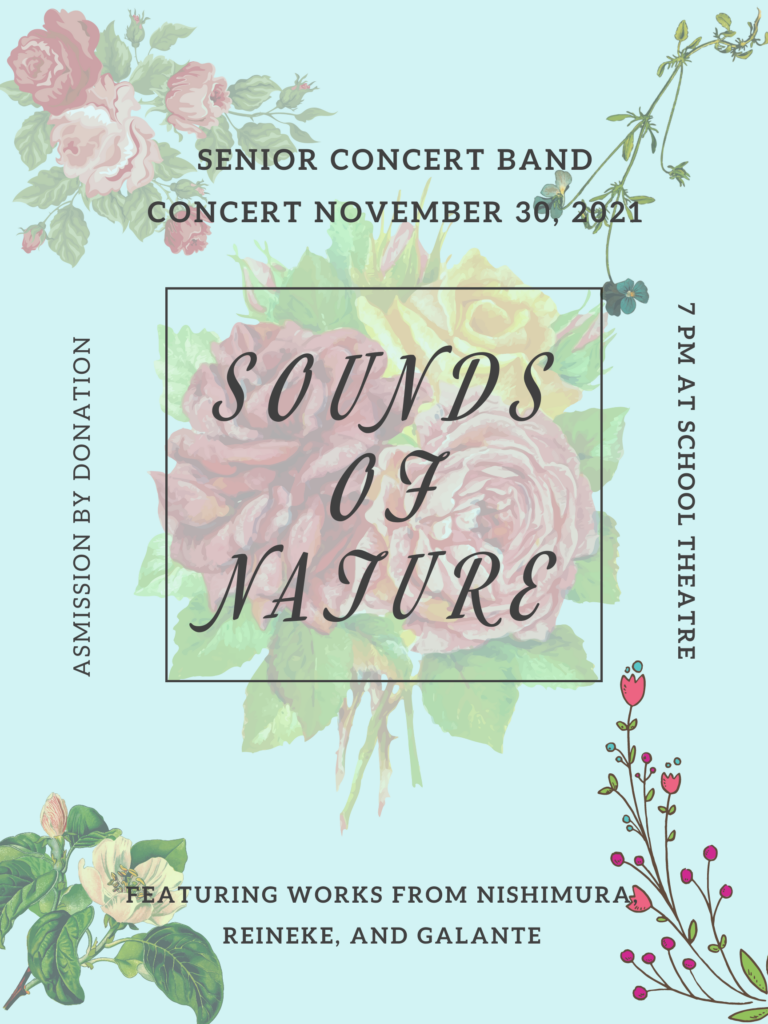
I thought that I would gain some more experience with creating images, so I made a concert poster for a unit I created for my teachable subject class! This will be something as a music educator, I will be doing often and decided to gain some experience. I used Canva for this because we did a workshop with it before.

I think that graphic design also can give students a way to teach us too, and take a sense of ownership in their learning. It can be a way to re-engage a learner who is completely disconnected. I do look forward to learning more tricks to use PowerPoint, and other tools to create!

EdTech Reflection #4

This week in class I enjoyed getting to learn about editing and screencasting! Though I had finished my introductory video before class, it was beneficial to go through the activities in class and get more ideas on how I can edit videos, as it is a common use of assessment in music and being able to pass these skills along to my students will be of benefit to them. One of my goals as an educator is to have my students be able to show their understanding of multiple methods, and these workshops enable me to give more support to future students in their endeavours.

I did create this screen capture, however, my computer will currently not record the audio, though I did set it up properly. So hopefully in the future, it will cooperate! I restarted my computer as asked by the chrome extension to no avail, but I feel comfortable setting that up next time!

Open Education

I found this week’s class on open education very useful. As teachers, we want to share knowledge, and every teacher I have met says “If you like an idea or technique, take it! Credit it a few times, then just keep doing it”. It was nice seeing people posting content for others to use (of course giving credit where credit is due is always important!) to benefit the greater good of learning around the world. I think that the open textbooks on the B.C Open textbook project, in particular, is an incredible resource because it makes education and learning more accessible for anyone. Also, OER commons is wonderful; particularly to me because it is likely I will be the only teacher in my subject in my school, so having resources online to look at in the absence of subject-specific colleagues is comforting. I think a fascinating thing to do for my learning and practicing, is finding a resource that I am allowed to modify and try to indigenize it and make it applicable to my teachable if it isn’t. Or, use them as ways to practice writing learning outcomes for my students. I look forward to discovering more sources and ways to use them, and I think these are incredibly beneficial for teachers, especially in rural areas.

Reflection #2- Technology in the Classroom

I find the whole debate surrounding technology rather fascinating. When I was in high school, they were almost never allowed in the classroom (truly, maybe one or two times a school year) and though I’m not long removed from high school, the attitude surrounding them has changed completely.

Personally, I can’t say I love the idea of allowing students to blatantly be on their phones in class, but I am also in a teachable subject that there is a lot of hands-on doing and collaboration, so being on their phones doesn’t only affect them, but negatively impacts the entire class. But I do see the upside to them. Talking to a teacher at my observation school, they said that for a lot of students who have a lot of anxiety or ADHD, they use them to stimulate themselves quietly, so they can still be present in the classroom and hopefully learn something. This conversation with them really opened my eyes, because really, at the end of the day we are there for our students, and anyway that they are in the classroom is always a good day.

Going back to Jesse’s chat today was interesting, though I can’t say remarkably eye-opening, he did have a lot of good insight into how to meet them in the middle. Using his example of twenty minutes of class and 2 minutes on their phones could work, but it really depends on the classroom. I do think that their phones can be a great tool for assessment (things like Kahoot, or surveys) to see where they are at that moment, and giving them a silent, anonymous way to demonstrate that is really important. I always appreciate that as a student and as a person who is very shy and lacks the confidence to speak in class.

It is also critical in giving special needs students an opportunity to participate in class, particularly when teachers do not make sure the content they show is captioned or offered with described video or an image description. Technology, particularly in the convenience of a cell phone has made the world more accessible; even zoom, though most folks hated it. Being online gave students who needed accommodations the opportunity to participate in a greater way because their learning environment was more accessible. I definitely benefited from this, because I could turn up the volume of people in zoom to what I needed, so being back in person and wearing masks has negatively affected how I can participate in classes because people’s voices are muffled. (Though, I would not feel comfortable in a maskless classroom at the moment, personally) I am not writing this for pity, but, I think it’s important for able-bodied folks to realize how online education was actually quite a bit more accessible than in-person education is for many people, and we have technology like zoom to thank for that.

I appreciate that we have talked about the legalities of being a teacher in a social media-influenced world, because we have to protect our students, and so I am grateful for that, and it has opened my eyes to what privacy is. Why is a direct message on Instagram wrong, given only the people involved can see it when an email is seen as acceptable, though only the people involved see it? Is it the servers they are hosted on, the companies they are owned by? These are the kind of questions I hope to gain some clarity on in the coming weeks.

« Older posts